

What is Dubai's Basketball Team Doing Competing in the EuroLeague?
The Emirati club made history as one of the only teams from outside the continent to play in the competition.

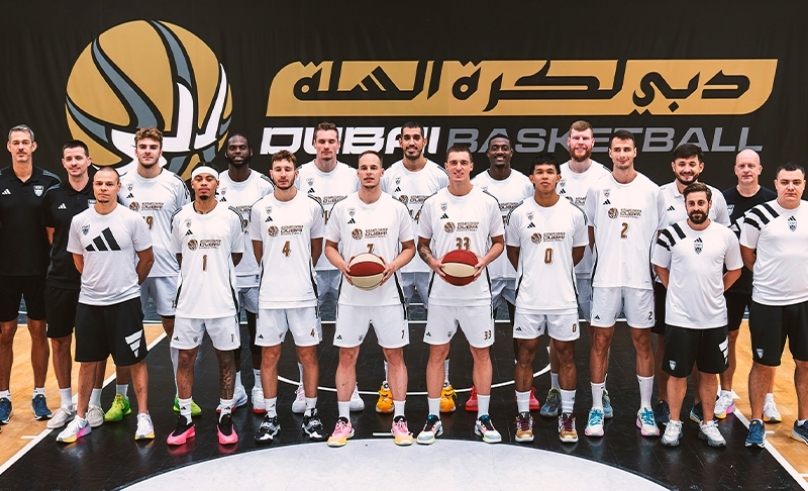
In September 2025, Dubai stretched the confines of Europe’s sporting borders when the city became home to one of the only teams outside of the continent to play in basketball’s EuroLeague. The move was both strategic and symbolic. For many it was also, on the surface, extremely surprising.
Its execution, however, was far from that. The groundwork and foundations, both direct and indirect, was being set for longer than the team’s young two-year history would suggest.
Dubai Basketball was founded in 2023 under private ownership, with co-founder and General Manager Dejan Kamenjasevic at the helm, and the national tourism authority as a partner. From the outset, the project positioned itself a long-term expansion play, built around infrastructure, market reach, geography and future investment in basketball in the region.
The stars began to align even before the club officially took shape. The 17,000-seat Coca-Cola Arena opened in June 2019, later becoming the franchise’s first home and providing the infrastructure required for top-tier European competition. With an arena and investment in place, the next step on its path to the EuroLeague came in January 2024, when Dubai Basketball was granted a three-year license to compete in the ABA League.
The competition features clubs from southeastern Europe, including Bosnia and Herzegovina, Croatia, Montenegro, North Macedonia, Serbia, and Slovenia, along with EuroLeague heavyweights Red Star Belgrade and KK Partizan.
-ed9b791f-3c2f-4448-a887-cc4bb9b4b939.jpg) The escalation was immediate. Beginning in 2024, Dubai regularly faced Balkan opposition, effectively operating as a live test case for a club competing outside traditional European geography. After only 12 months of testing in the ABA League, the journey continued.
A club can enter the EuroLeague in three ways: through a wild card ranging from one to five years after clearing entry criteria, or via EuroCup promotion which grants the winner a one-year slot, or through an A-license, a permanent shareholding position currently held by 13 clubs. In practice, the wild card route remains the most viable for emerging projects, particularly those outside established European markets like Dubai Basketball.
The escalation was immediate. Beginning in 2024, Dubai regularly faced Balkan opposition, effectively operating as a live test case for a club competing outside traditional European geography. After only 12 months of testing in the ABA League, the journey continued.
A club can enter the EuroLeague in three ways: through a wild card ranging from one to five years after clearing entry criteria, or via EuroCup promotion which grants the winner a one-year slot, or through an A-license, a permanent shareholding position currently held by 13 clubs. In practice, the wild card route remains the most viable for emerging projects, particularly those outside established European markets like Dubai Basketball.-612a9085-aad2-473a-8b47-cad71123bee7.jpg) For the 2025/2026 EuroLeague season, the competition expanded to 20 teams, extending the calendar to 38 rounds. That move opened the door for Dubai Basketball to make history. The club was granted entry on a five-year contract starting in September 2025, a long-term wild card that runs through 2030 and signals commitment from both the league and the project. The deal, longer than the usual three-year licenses, positioned Dubai as part of the competition’s expanding future.
"What we did is we gave this five-year vision together, with the EuroLeague, because this is the best basketball competition in Europe,” Kamenjasevic said during a press conference in September. He added that joining the EuroLeague is the most logical decision that could have been made.
For the 2025/2026 EuroLeague season, the competition expanded to 20 teams, extending the calendar to 38 rounds. That move opened the door for Dubai Basketball to make history. The club was granted entry on a five-year contract starting in September 2025, a long-term wild card that runs through 2030 and signals commitment from both the league and the project. The deal, longer than the usual three-year licenses, positioned Dubai as part of the competition’s expanding future.
"What we did is we gave this five-year vision together, with the EuroLeague, because this is the best basketball competition in Europe,” Kamenjasevic said during a press conference in September. He added that joining the EuroLeague is the most logical decision that could have been made.
-c92bce83-3b6e-4468-9bca-42036df8e68b.jpg) The timing also reflected a broader basketball surge across the UAE. The EuroLeague’s expansion arrived shortly after Abu Dhabi hosted the 2025 Final Four, a milestone moment that further positioned the region within the sport’s global calendar. That momentum had already been building through the NBA Abu Dhabi Games, which began in 2022 and quickly became a recurring stop for preseason matchups.
According to YouGov research, basketball participation in the UAE has increased by 60% since the inaugural NBA Abu Dhabi Games in 2022.
The league’s fanbase in the UAE has also grown by more than 25%, reinforcing the region’s emergence as a major basketball hub, supported by ongoing NBA preseason games and the launch of a new global academy.
If the next five years are successful, the implications could extend beyond a single franchise. Dubai’s presence may open the door for additional expansion into new markets, deepen the league’s ties to the Gulf, and reshape the competitive map of European basketball.
The timing also reflected a broader basketball surge across the UAE. The EuroLeague’s expansion arrived shortly after Abu Dhabi hosted the 2025 Final Four, a milestone moment that further positioned the region within the sport’s global calendar. That momentum had already been building through the NBA Abu Dhabi Games, which began in 2022 and quickly became a recurring stop for preseason matchups.
According to YouGov research, basketball participation in the UAE has increased by 60% since the inaugural NBA Abu Dhabi Games in 2022.
The league’s fanbase in the UAE has also grown by more than 25%, reinforcing the region’s emergence as a major basketball hub, supported by ongoing NBA preseason games and the launch of a new global academy.
If the next five years are successful, the implications could extend beyond a single franchise. Dubai’s presence may open the door for additional expansion into new markets, deepen the league’s ties to the Gulf, and reshape the competitive map of European basketball.