

How I Learned to Describe 'Nothing' as a World Cup Commentator
A first-person account of commentating the beautiful game for blind and visually impaired fans.
Describing a goal is easy, relatively speaking. Screaming “GOAL” isn’t enough, however, when you’re describing it to a blind or visually impaired fan. Who scored? How? With which foot? All valid questions.
But that’s not even the difficult part.
The real challenge is the six minutes before the goal, when the ball is moving but nothing much is happening. The supporter still needs to know where it is, who has it and what’s happening around it.
So you keep describing.
Ahead of the 2022 World Cup in Qatar, I came across a post asking for volunteers to become English-language commentators for blind and visually impaired football supporters through audio description services. It sounded vaguely exciting, so I immediately decided it might change the direction of my life – something I do quite often, usually before losing interest somewhere between filling out the form and attending the introductory call.
This time, I didn't lose interest.
I drove to a university building and entered a room containing 26 other people who'd apparently experienced the same temporary surge of self-belief.
There was a football knowledge and terminology test. Within a short period, 26 became 14. I survived.
Naturally, at that point, I decided I was going to become the next Peter Drury - the British commentator whose voice has coloured dozens of iconic footballing moments across a decades-long career. I wanted the language, the speed and the ability to make a Thursday-night Europa League match sound like the final battle of a collapsing empire.
Unfortunately, I failed the assessment.
I tried again. Then I failed again.
Eventually, my instructor and tutor told me that if I genuinely wanted to become a commentator, I'd have to do it in Arabic. He was right.
Commentary isn't only about speaking a language well. It's about thinking in that language without hesitation, finding the word that exists now rather than the better word that arrives four seconds later, after the ball's already gone out for a throw-in and the entire match has moved on without you.
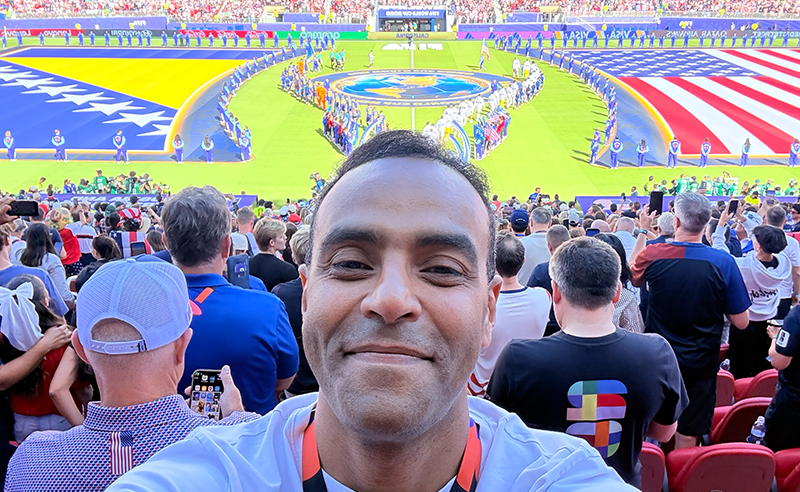
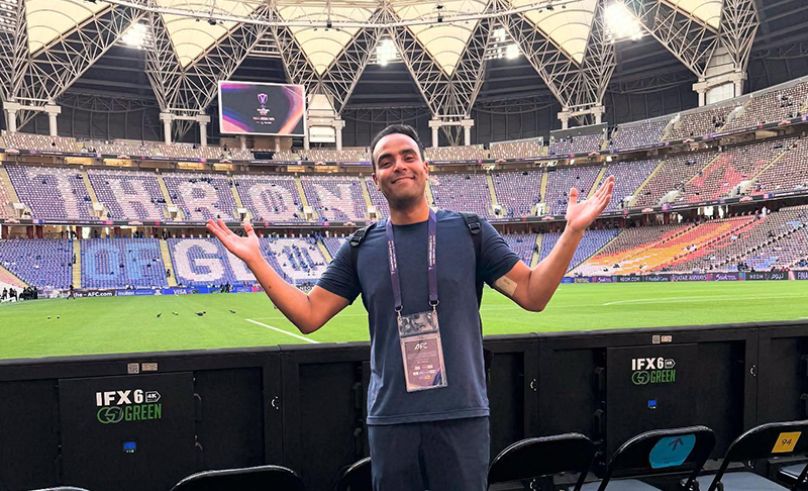
Six months later, my final assessment involved a random 45-minute stretch of a World Cup match. I got a goalless stretch of England vs Colombia: no goals, no drama, just the manual labour of making boredom accessible. I passed, then quickly I received the call: I'd become a commentator at the 2022 World Cup in Qatar.
That wasn't the last hurdle I'd have to jump, however.
The easiest way to misunderstand audio-description commentary is to think of it as ordinary commentary with a few extra details. You're inside the stadium with the supporters. They hear the chanting, feel the people around them stand and know something's happened because 50,000 supporters have suddenly erupted.
Your job is to explain why, instantly.
You have to account for every type of visual impairment, from partial sight to complete blindness, and you can't speak to the audience as though they know nothing about football.
A blind supporter who's travelled to a stadium, navigated the transport, passed through security and committed an entire afternoon to a football match probably isn't someone with a mild passing interest in the sport.
They may know more than you do.
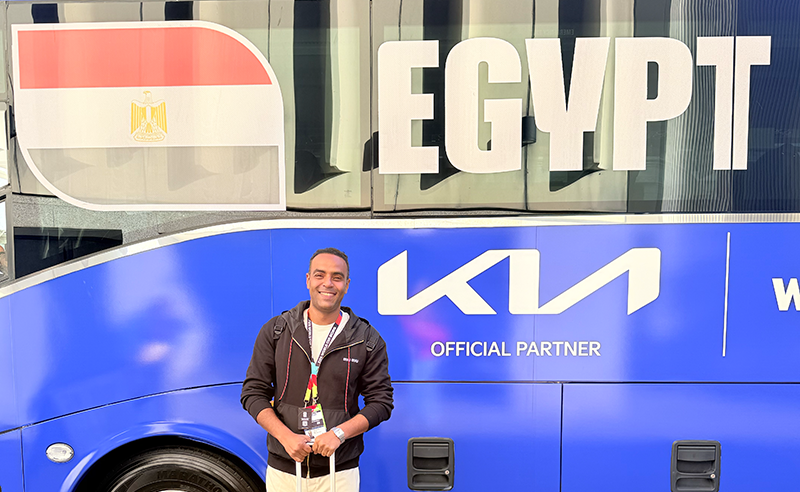
Your knowledge has to meet theirs and, ideally, exceed it. You have to become an encyclopaedia that can speak at the speed of a loose ball.
Then the 2022 World Cup arrived, and I quickly got a reality check that put a dampener on my romanticised expectations.
When you dream of becoming a World Cup commentator, you imagine France and Brazil. You imagine Neymar, Mbappé, Messi and Ronaldo. You imagine a semi-final in the 89th minute, a perfect cross, a header and a line of commentary that appears in montages for the next 30 years.
But that's not always the job.
Television commentators can drift during a boring match. They can tell a story about the manager, discuss a statistic or talk about a player's childhood while the viewer continues watching the centre-backs pass sideways. I can't drift for very long because the blind supporter can't see the sideways pass. I have to describe it.
The player is on the 18-yard line near the touchline. The ball moves from the centre-back to the defensive midfielder, eight metres behind the centre circle, then back to the centre-back and across to the other centre-back, two metres from the halfway line towards the right.
It moves forward briefly.
Then it comes back again.
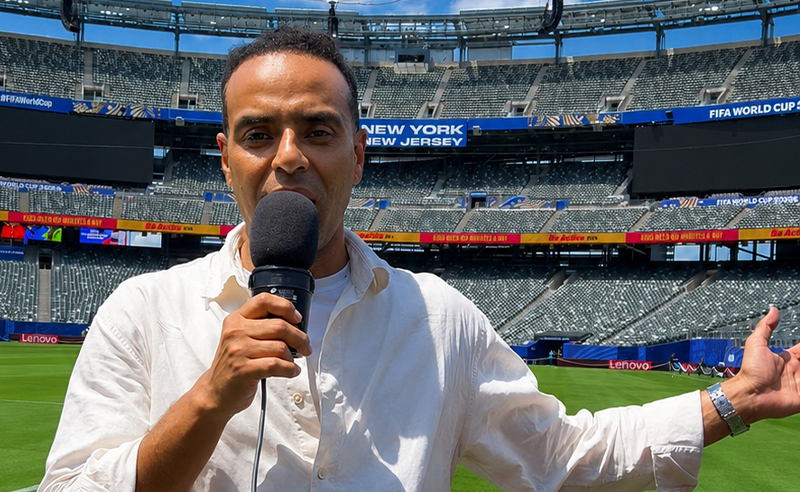
You say the player's name, describe exactly where he is and explain the pressure around him, perhaps adding a small fact because the match currently has the emotional intensity of a printer warming up.
You begin with the most interesting fact about Kim Young-Gwon, then move on to the second-most interesting, followed by the third. By the sixth slow passage across the defensive line, you're searching your notes to see whether he owns an unusual pet.
This is the hidden terror of audio description: dramatic matches carry you, while boring matches consume you.
You prepare far more information than you think any human being could reasonably require because a dull match will eat through facts like fire through dry grass. Your brain becomes a hard drive, and before each game you fill it with 26 players.
Between 2022 and 2026, I became better – not great, but better. I worked at the Euros and the Olympics, and I started to understand the rhythm more clearly: when to describe, when to pause and when to let the atmosphere speak for itself. I learned that the audience didn't need me to manufacture drama because football's already perfectly capable of producing its own.
Then 2026 arrived.
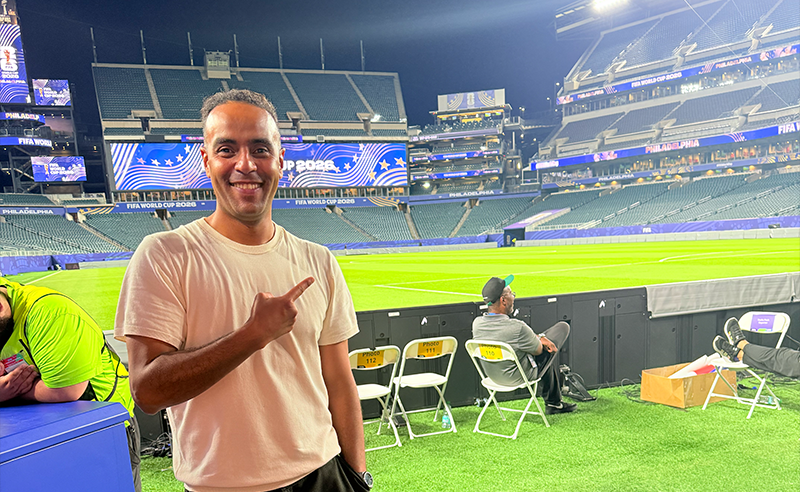
The system had changed. Commentary was divided into four quarters, with commentators rotating between describing the game and monitoring. You'd work, swap, listen and then return, which meant that occasionally you could sit inside a World Cup stadium and enjoy the football without being personally responsible for explaining the precise location of the ball.
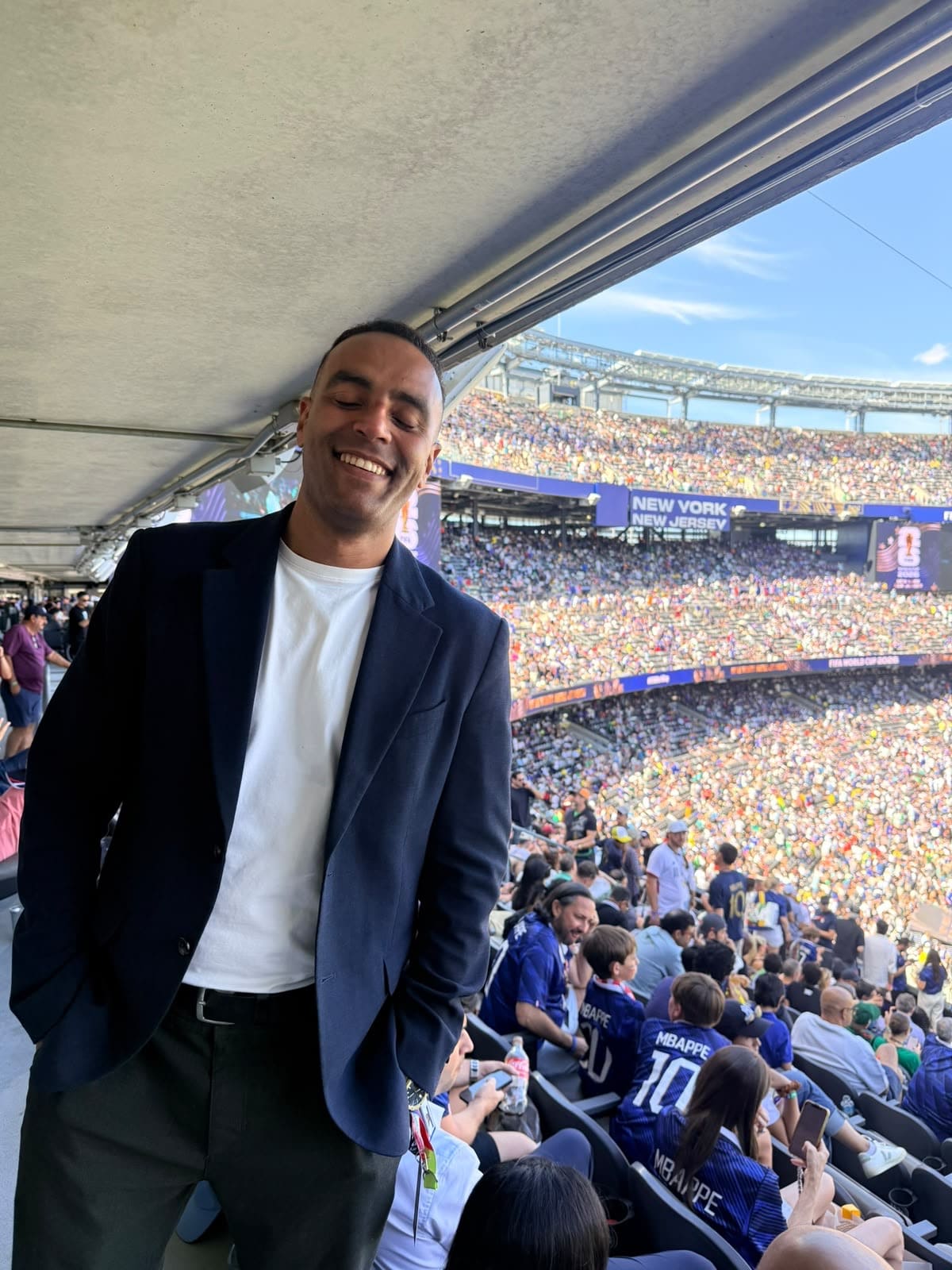
Before enjoying anything, however, you had to reach MetLife Stadium. MetLife is presented as a New York stadium in the same way some airports are named after cities despite being located in a different administrative reality, several transport connections away. You begin in New York with hope. You end up in rural New Jersey in despair.
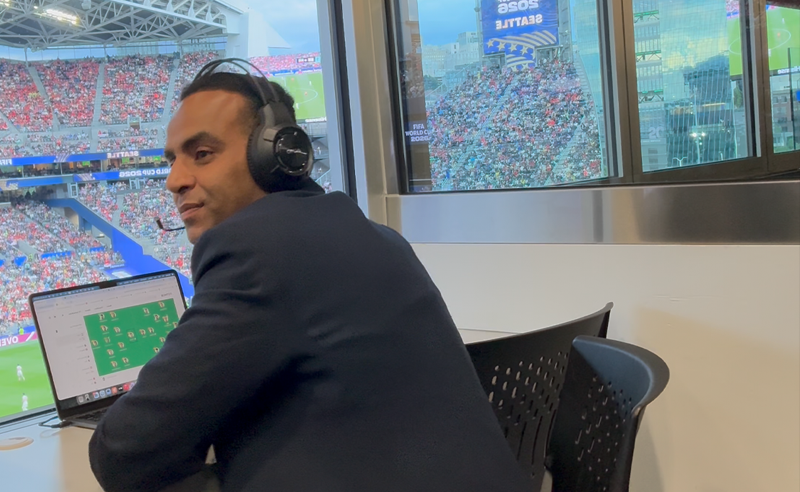
I travelled across America for the tournament, watching Brazil, France and the host nation. The more I travelled, the more I realised that America understands spectacle. It knows how to take a match, turn it into a story, turn the story into a clip and turn the clip into a meme before the final whistle.
But the match I'd been waiting for was Egypt against Iran in Seattle. From the moment the fixture was announced, I thought about it, dreamed about it and worried about whether it'd happen at all. When I arrived in Seattle, I found Egyptians filling the city. For that day, Seattle became an Egyptian city.
I'd seen something similar during my first World Cup experience in Saint Petersburg, when flags and shirts temporarily transformed part of the city into a piece of Egypt. But Seattle was different. This was the Egyptian diaspora in America, all suddenly in the same place.
People had flown in from across the country. They'd built lives thousands of miles from Egypt, but Egypt remained close enough to make them cross states and time zones for one match.
This is one of the things international football does better than almost anything else. It makes identity physically visible.
Around the stadium, everything organisers normally prefer to keep in tidy boxes had collided: football, diaspora, nationalism, protest, joy and thousands of people trying to find the correct entrance.
The energy outside was incredible. Inside, it became even louder. Egypt were shaky and relied on some luck, but the match was electrifying. Afterwards, I felt accomplished. Not just happy. As though I'd finally done the thing I'd been waiting to do.
Egypt against Iran had been the game I was waiting for, and once I'd commentated on it, something inside me decided that the central mission of the tournament was finished. By the Australia game, I'd become a spectator, which is one of the great benefits of the job. You have access and can attend matches, so I watched as much as possible and completed my bucket list.
I also started seeing the tournament differently. After spending so much time describing what was happening on the pitch, I began to notice the sheer cinema forming around it.
The World Cup gave every country a role in the show - not its football role, but the other role, the one that remains in people’s minds long after the tournament is over.
Norway became the tournament's breakout story, with Erling Haaland emerging not simply as a goalscorer but as an enormous, strangely lovable central character – a man built like a laboratory experiment who somehow became one of the tournament's warmest presences and one of the most loved superstars on Earth.
Argentina became the villains. Cape Verde was the impossible underdog film: a tiny nation arrives, nobody expects anything, then nearly knocks out Argentina in a match that sounds increasingly fictional every time you explain it.
Spain were 'Moneyball': less romance, more system, with every inefficiency identified and passed around until the opposition disappeared. Egypt, under Hossam Hassan, became 'Coach Carter' crossed with 'Any Given Sunday': an old-school coach, a team running on pressure and belief, and an entire country treating every match like the final scene.
The World Cup gave every country a role in the show – not its football role, but the other one, the role that remains in people's minds after the match is over and the result has started to fade. The goals become clips. The tournament becomes the characters we loved, the villains we hated and the stories we couldn't believe.
The parts we'll continue retelling as though the whole thing had been scripted for us.
I began all of this wanting to become the next Peter Drury, producing immortal lines while the greatest players in the world did immortal things.
Instead, I learned that the most important sentence in commentary is often not poetry. Sometimes it's simply: the centre-back has the ball, two metres from the halfway line, and nothing's happened yet.
Because 'nothing' is still part of the match. And someone still needs you to describe it.
- Previous Article Egypt to Compete at U16 Water Polo World Championships
- Next Article UFC is Bringing World-Class MMA Action to Abu Dhabi on October 24th